
Thought for this day. 14 June 2015
Consider the scenario, you are stopped by the traffic police and politely asked “do you know what speed you were traveling at sir”, by the time you have read these musings you will know the precise definitive response to give.
We are all moving around at a vast range of velocities relative to other objects in the Universe and we can claim to be moving at almost any velocity we like by simply choosing an appropriate reference object. In other words there is no absolute reference frame to which the motion of all other objects can be referred. For example, if we are standing on the earths equator we are travelling at about 1000 miles per hour relative to the earths centre, about 67,000 mph relative to our local star the sun, and about 490,000 mph relative to the centre of our own galaxy the Milky Way, and so on.
In 1887 Michelson & Morley published the results of their unique experiment establishing that the speed of light was a constant of nature and independent of the state of motion of the source emitting the light and the observer seeing it. In 1905 Einstein carried out a thought experiment in which he imagined what the world would look like if he could observe it from a privileged position sat on a beam of light. Out of this came his Special Theory of Relativity in which light always travels at the same velocity no matter who makes the measurement. Thought experiments like this are available to us all. They require no expensive laboratory or equipment, it’s free to everyone inside their head. Give it a try.
Consider the implications inherent in Einsteins theory of special relativity. If I am stationary relative to the Earths surface and an airplane flies past me overhead, if I measure the length of the aircraft and the rate at which an on board clock ticks, I will arrive at different values compared to someone on board the plane taking the same measurements. Further, if another observer , say someone on a train moving at a different speed relative to the earth and the plane takes the same measurement he will arrive at yet another set of readings which are different again. Who has taken the correct measurement? We will all claim to have done so from our unique perspective. Further, because speed is simply distance divided by the time taken to travel that distance, both distance and time being dependent on the state of motion of the person making the measurements, the validity of our speed measurement is also brought into question. These differences in observed distance, time and velocity are a consequence of the property of nature restricting the speed of massless particles including light to a cosmic speed limit of approximately 186,000 miles per second (300,000,000 meters per second), and that this is independent of the state of motion of the observed and the observer. In other words it would appear that distance and time must change in such a manner as to keep the speed of light constant. The problem with this is that observers would report conflicting measurements when recording an event. This is an untenable situation , especially to a physicist.
Einstein resolved the situation by combining the three spacial dimensions of length breadth and height with time in such a way that measurements made in spacetime would be agreed on by all observers no matter what their state of motion. In other words measurements of how far apart two events were in spacetime would be invariant. Two observers may disagree over the distance between two events and the time at which they occurred but they would both agree on the spacetime interval (s).
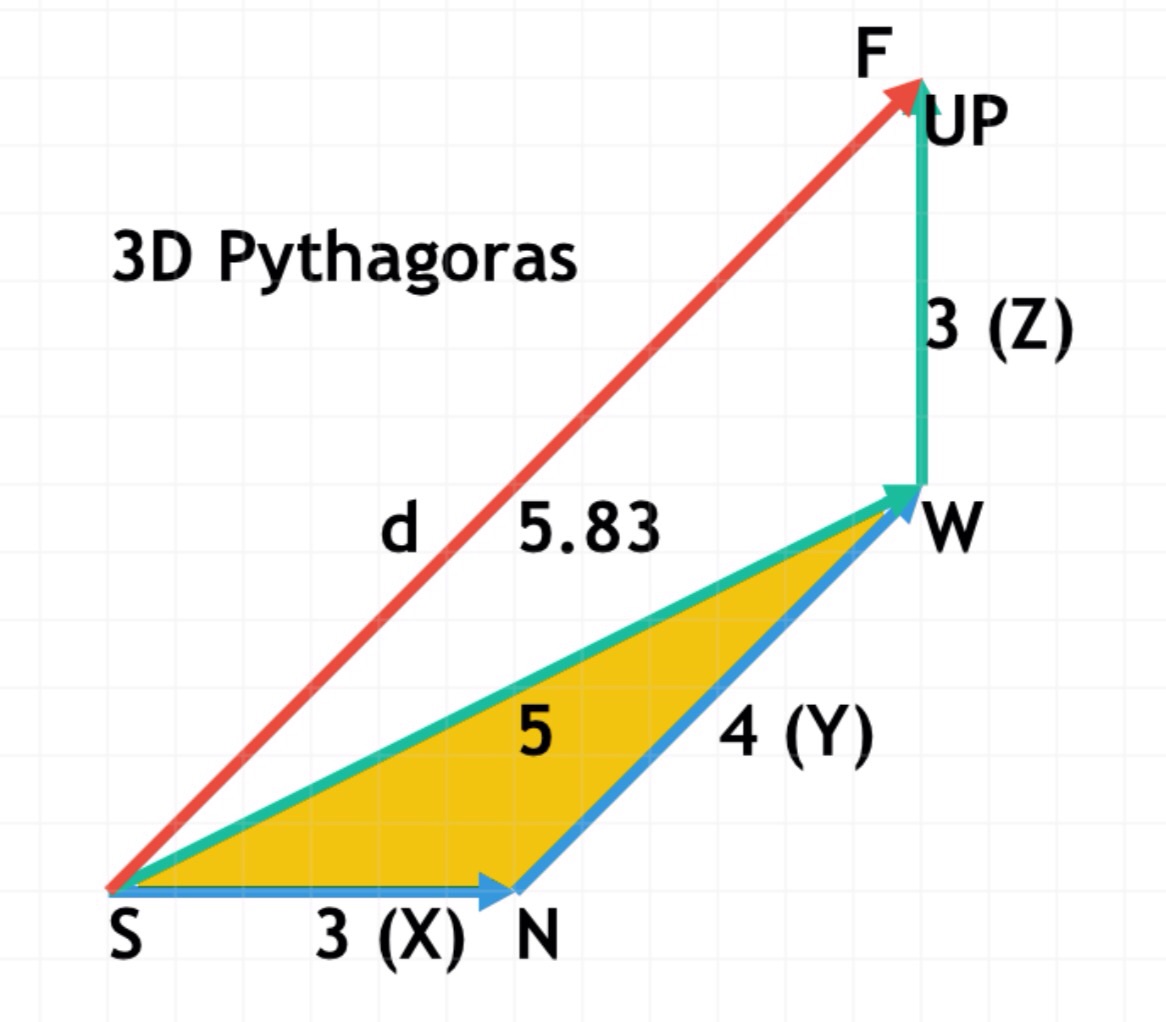
We are all familiar with how distances given in terms of three orthogonal directions can be combined using the theorem of Pythagoras to provide the distance between two points in space. That is, if we square each of the three component values and add them together it will give the square of the distance between start and end points (S & F in the figure above). For example, if we moved 3 units in the X direction say due north, 4 units in the Y direction say due west, and finally 3 units in the Z direction vertically upwards we will be 5.83 units from where we started. This combined XYZ distance we will call “d”. ( ie d2=X2+Y2+Z2). This can be extended to include any number of dimensions but of course as a human being we have not yet evolved to be able to visualise more than three.
It is tempting to extend this process to incorporate time by simply squaring its value and adding that to the spacial dimensions. However, this is dimensionally inconsistent adding seconds squared to metres squared is rather like adding apples to oranges. Before the time component can be added in it must be converted into an equivalent length in metres. That is, it must be multiplied by a conversion factor having units of metres per second (ie a velocity) allowing the seconds to cancel out leaving metres. After all this is nothing new in astronomy it is common practice to measure distances in light years, where a light year is the distance travelled by light in one year.
If this method of combining distance and time is adopted, everyone no matter how they are moving relative to one another will report the same spacetime interval (s) between all observed events but they will not necessarily agree on the order in which two events take place, this is referred to as a breakdown in causality.
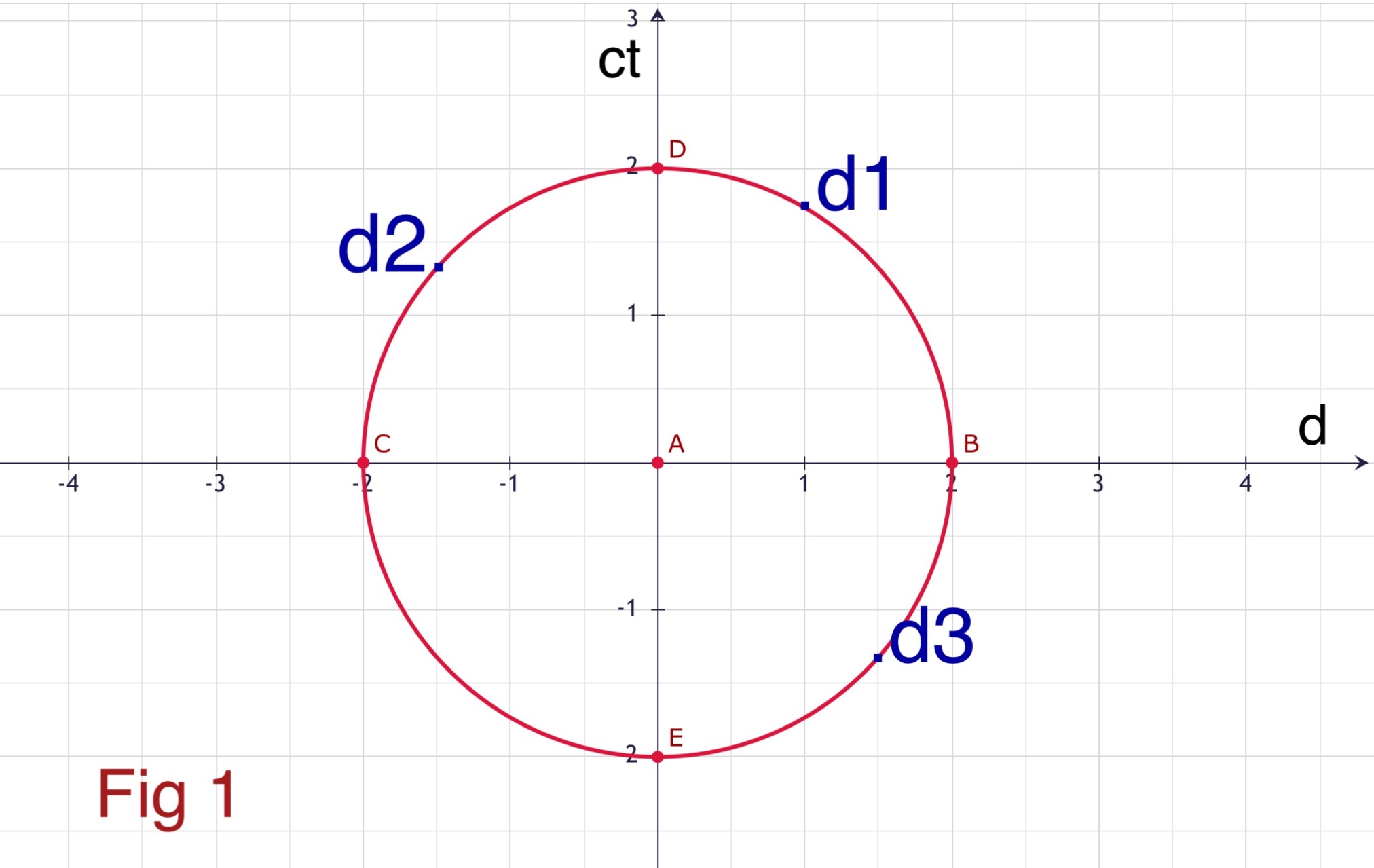
Figure 1 illustrates the result of combining space and time in this way by first representing the three spacial coordinates by the symbol “d”.The value of d is plotted on the horizontal axis of the graph in figure 1 and ct on the vertical axis. This ruse allows us to visualise the effects of combining space and time on a two-dimensional sheet of paper. Our brains are not hard-wired to comprehend a four-dimensional representation all in one go.
Figure 1 is a graph of (ct)2 + d2 = s2 or in terms of ct, ct = √(s2-d2). This is observed to be a circle of radius s. In this specific example s is chosen to be of value 2. The three points indicated as d1, d2 & d3 all have different values of d and ct as measured by observers travelling at different relative velocities but they all agree on the value of spacetime interval s = 2. Therefore, this strategy seems to have complied with the requirement of invariance. However, there is seen to be a problem with causality. The points d1 & d2 place the observed event in the future (ie ct has a positive value) but d3 occurs in the past (ct has a negative value). Whether an event is observed to occur in the future or the past should not depend on the state of motion of the observer. This hypothesis must therefore be rejected.This is a consequence of the constant s graph crossing over the horizontal axis which divides past and future events.

The only other possible hypothesis consistent with an invariant spacetime interval and maintenance of causality was to subtract the squares of spacial coordinates from the square of the modified time coordinate. That is (ct)2 – d2 = s2 or in terms of ct, ct = √(d2 + s2). The graphical representation of this function is the red curve of figure 2 above. This is called a hyperbola and is the shape familiar to us in the outline of power station cooling towers against the sky. Note that the graph does not cross the horizontal axis and therefore an event considered to be in the future by one observer will be considered so by all observers. The green dotted line represents the function ct = d, or ct/d = 1, that is, for 5 units traveled along the horizontal axis we travel 5 units up the vertical axis, therefore it is at an angle of 45 degrees to each of the two axes. We say the line has a gradient of one. It is seen that as d becomes very large the curve approaches, but never quite reaches it from above. The green dotted line is called an asymptote of the graph. The ratio ct/d can be rearranged as c/(d/t), d/t is of course the relative velocity “v”, therefore the green dotted line represents the relationship c/v = 1 or c = v. The gradient of the red line graph is seen to increase from zero at the origin ( ie at d = 0) to a limiting value of 1 as d becomes very large. This corresponds to a relative velocity increasing from zero to a limiting value of c as the graph skims along the asymptote for large values of d. The value of our conversion factor c is seen to represent a limiting velocity beyond which we cannot travel through space. In fact it is easily shown that c is the velocity of light.

Figure 3 illustrates three cases in which the spacetime interval is fixed at a value of 2 meters (red), 4 meters (green) and 5 meters (blue) respectively. In a situation in which an object is moving through spacetime and the spacetime interval is changing, an observer would see a smooth transition from one curve to another the actual curves illustrated in fig 3 being snapshots of the object taken at distinct epochs during the translation process. Now if an object is observed to move through spacetime the question arises can its motion be described in terms of a measured velocity? We cannot simply divide s by t, because the spacetime interval s is invariant and its value agreed on by every one, but time t is not. Looking at our previous equation describing motion through spacetime ((ct)2 – d2 = s2) the only invariant terms are c and s. To obtain an invariant equivalent of time in terms of c and s we could divide s by c (ie s/c) which would have the dimensions of seconds as required (ie metres/metres per second). If we now divide our spacetime interval s by s/c we would have the required velocity through spacetime. That is s/(s/c), s will cancel leaving just c the speed of light. A consequence of this mathematical juggling act is that every object in the Universe is moving through spacetime at the same velocity, namely 300,000,000 metres per second, that is the speed of light, or to be more precise the velocity of massless particles of which light is just one.
This velocity is shared between the space direction and the time direction in our spacetime world. Therefore if we consider ourself stationary relative to say the earths surface, all our 300,000,000 metres per second would be in the time direction only. If we get in a car and travel across the earths surface at speed, some of this speed would now be along the space direction at the expense of that along the time direction, therefore our clock would slow down to reflect this situation. However when the two components of velocity are merged back into spacetime using the difference of squares method, the resulting velocity is 300,000,000 metres per second and always will be. It’s just that our speed is divided up in different proportions between the space and time components, one being vied off against the other. In the extreme case where an object is travelling through space at the speed of light it’s component along the time direction becomes zero and a clock travelling with the object would stop, that is time itself would have stopped for that object.
Figure 4 illustrated three cases.
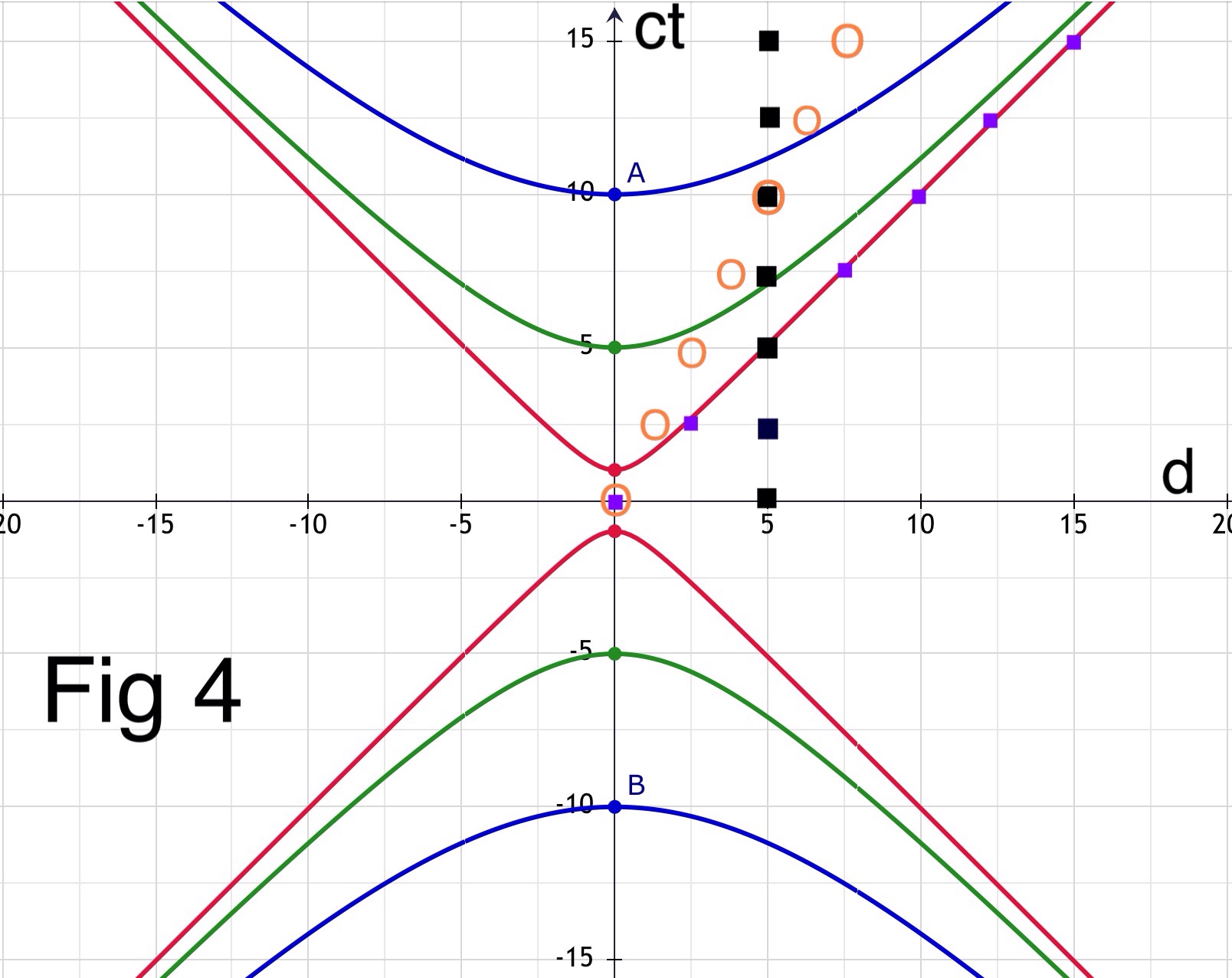
It will be assumed that all velocities are relative to a frame of reference in which the observer is at rest. The black line delineates the path of an object stationary in space at 4 metres from the origin therefore it’s motion is described by a vertical line parallel to the ct axis. It’s motion is therefore along the time axis only, traveling 300,000,000 metres every second in time.The purple line delineates the path of an object traveling at the speed of light c in the space direction therefore has no component along the time axis at all. Therefore time would stand still for such a traveller. (no point in wearing a watch). The orange line delineates the path of an object traveling through space at half the speed of light and hence its speed along the time axis will have been reduced accordingly.
Einsteins theories are not illusionary, they have real measurable consequences and have been verified by experiment countless times. In fact if they were not taken into account our satnav systems would be grossly inaccurate and unusable. Our current satnav system comprises 24 satellites orbiting at an altitude of 20,000 km, completing two earth orbits per day at an orbital speed of 14,000 km/hr. As a consequence of Special relativity clocks on the Satalites lose 7μs per day, and as a consequence of general relativity ( due to the weaker gravitational field at 20,000 km above the earths surface ) they gain 45 μs per day the net effect being a gain of 38 μs per day. This, if uncompensated, would result in a positional inaccuracy of 10,000 km per day.
There is one problem with the theory as described above. If instead of subtracting the square of the spacial component from the square of the time component to combine space and time we do it the other way round, subtracting the square of the time component from the square of the spacial component. Then a mathematically valid variant would be obtained in which everyone would agree on the distance apart of two events in spacetime but causality would not always be conserved. However, using this solution involves a side effect, that all objects following this version of the theory would always be travelling faster than the speed of light. This is illustrated in figure 2 as the blue curve in which the gradient is always steeper than the c = v asymptote and it crosses the horizontal time equals zero axis. This breakdown in causality would mean that you could be born before your mother, but providing information about the event could not be transmitted faster than the speed of light there is no way either of you would know anything about it, or use the information to influence the future.
The answer to the original question posed at the beginning of my musing is “yes officer like yourself I was traveling at 186,000 miles per second”.
Something to think about whilst sat in your prison cell.
Just as we can draw a line on a two-dimensional sheet of paper we all leave a unique trace in the four dimensions of spacetime. Each animate and inanimate object, including humans, as they hurtle through spacetime, leaves an indelible trace recording this journey. Interactions between objects would be recorded as intersecting lines or lines travelling together touching for a certain distance depending on the duration of the interaction. A permanent record of the past exemplified as a tangle of twisted contorted lines in spacetime.
What about the future? It may even be possible for traces to exist in spacetime, mapping out the future, along which objects have yet to travel. No matter how difficult this is to believe it must be at least as plausible as being born before your mother.
Omar Khayyam may have been right after all in his predestined view of the world. Are we just actors acting out a plot in a universal drama in which our actions and dialogue has already been written, I hope not! I’d like to feel I had some say in the course of my life wouldn’t you?

Alice in Wonderland has nothing on the everyday world in which we live. Perhaps that’s what the Cheshire Cat was smiling about. Isn’t it wonderful how amazing the world and it’s laws are and trying to explain them, no matter how implausible they seem, is what makes us human.
Acknowledgement
This musing would not have been possible without the help of many people including Albert Einstein, Brian Cox, Pythagoras of Samos, Max Plank, Omar Khayyam, Lewis Carrol a rather annoying Cheshire Cat and many others too numerous to mention including an anonymous police officer with no sense of humour.
B Kershaw.
 fanfold universe