
Bertrand Russell
Bertrand Russell, (born May 18, 1872, Trelleck, Monmouthshire, Wales—died Feb. 2, 1970, Penrhyndeudraeth, Merioneth), British philosopher, logician, and social reformer, founding figure in the analytic movement in Anglo-American philosophy, and recipient of the Nobel Prize for Literature in 1950. Russell’s contributions to logic, epistemology, and the philosophy of mathematics established him as one of the foremost philosophers of the 20th century. To the general public, however, he was best known as a campaigner for peace and as a popular writer on social, political, and moral subjects. During a long, productive, and often turbulent life, he published more than 70 books and about 2,000 articles, married four times, became involved in innumerable public controversies, and was honoured and reviled in almost equal measure throughout the world. Russell’s article on the philosophical consequences of relativity appeared in the 13th edition of the Encyclopædia Britannica.
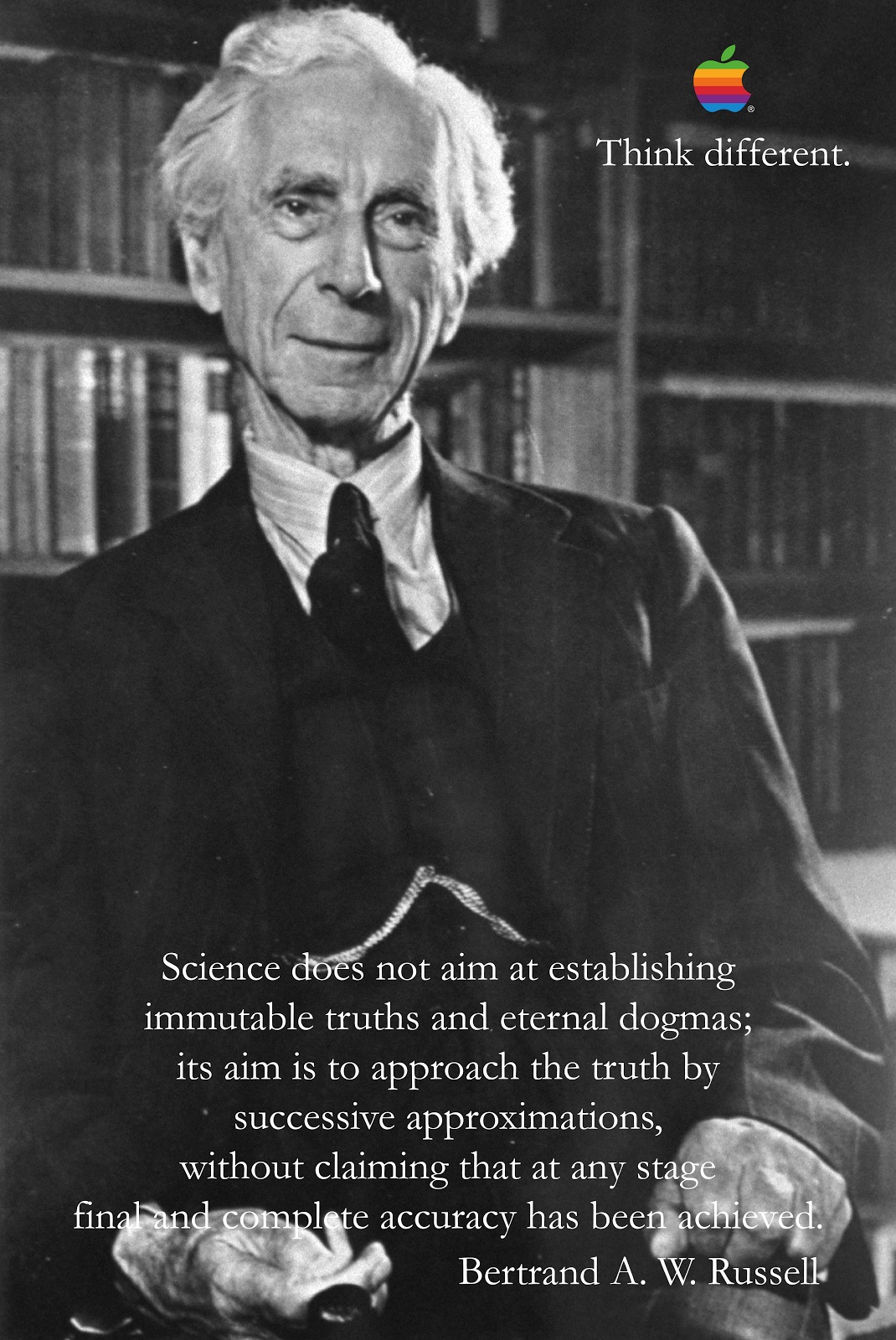
Bertrand Russell
A selection of his writings, thoughts and philosophy.
The Ten Commandments that, as a teacher, I should wish to promulgate, might be set forth as follows:
1. Do not feel absolutely certain of anything.
2. Do not think it worth while to proceed by concealing evidence, for the evidence is sure to come to light.
3. Never try to discourage thinking for you are sure to succeed.
4. When you meet with opposition, even if it should be from your husband or your children, endeavour to overcome it by argument and not by authority, for a victory dependent upon authority is unreal and illusory.
5. Have no respect for the authority of others, for there are always contrary authorities to be found.
6. Do not use power to suppress opinions you think pernicious, for if you do the opinions will suppress you.
7. Do not fear to be eccentric in opinion, for every opinion now accepted was once eccentric.
8. Find more pleasure in intelligent dissent that in passive agreement, for, if you value intelligence as you should, the former implies a deeper agreement than the latter.
9. Be scrupulously truthful, even if the truth is inconvenient, for it is more inconvenient when you try to conceal it.
10. Do not feel envious of the happiness of those who live in a fool’s paradise, for only a fool will think that it is happiness.
I do wish I believed in the life eternal, for it makes me quite miserable to think man is merely a kind of machine endowed, unhappily for himself, with consciousness.
The past alone is truly real: the present is but a painful, struggling birth into the immutable being of what is no longer. Only the dead exist fully. The lives of the living are fragmentary, doubtful, and subject to change; but the lives of the dead are complete, free from the sway of Time, the all but omnipotent lord of the world. Their failures and successes, their hopes and fears, their joys and pains, have become eternal—our efforts cannot now abate one jot of them. Sorrows long buried in the grave, tragedies of which only a fading memory remains, loves immortalized by Death’s hallowing touch these have a power, a magic, an untroubled calm, to which no present can attain. …On the banks of the river of Time, the sad procession of human generations is marching slowly to the grave; in the quiet country of the Past, the march is ended, the tired wanderers rest, and the weeping is hushed.
In the visible world, the Milky Way is a tiny fragment; within this fragment, the solar system is an infinitesimal speck, and of this speck our planet is a microscopic dot. On this dot, tiny lumps of impure carbon and water, of complicated structure, with somewhat unusual physical and chemical properties, crawl about for a few years, until they are dissolved again into the elements of which they are compounded.
Dreams and Facts (1919).
It seems to me now that mathematics is capable of an artistic excellence as great as that of any music, perhaps greater; not because the pleasure it gives (although very pure) is comparable, either in intensity or in the number of people who feel it, to that of music, but because it gives in absolute perfection that combination, characteristic of great art, of godlike freedom, with the sense of inevitable destiny; because, in fact, it constructs an ideal world where everything is perfect and yet true.
The fact that all Mathematics is Symbolic Logic is one of the greatest discoveries of our age; and when this fact has been established, the remainder of the principles of mathematics consists in the analysis of Symbolic Logic itself.
Principles of Mathematics (1903)
What does not exist must be something, or it would be meaningless to deny its existence; and hence we need the concept of being, as that which belongs even to the non-existent.
Principles of Mathematics (1903)
Arithmetic must be discovered in just the same sense in which Columbus discovered the West Indies, and we no more create numbers than he created the Indians.
Principles of Mathematics (1903)
I have been merely oppressed by the weariness and tedium and vanity of things lately: nothing stirs me, nothing seems worth doing or worth having done: the only thing that I strongly feel worth while would be to murder as many people as possible so as to diminish the amount of consciousness in the world. These times have to be lived through: there is nothing to be done with them.
Both in thought and in feeling, even though time be real, to realise the unimportance of time is the gate of wisdom.
I hate the world and almost all the people in it. I hate the Labour Congress and the journalists who send men to be slaughtered, and the fathers who feel a smug pride when their sons are killed, and even the pacifists who keep saying human nature is essentially good, in spite of all the daily proofs to the contrary. I hate the planet and the human race – I am ashamed to belong to such a species.
Real life is, to most men, a long second-best, a perpetual compromise between the ideal and the possible; but the world of pure reason knows no compromise, no practical limitations, no barrier to the creative activity embodying in splendid edifices the pass
It is preoccupation with possession, more than anything else, that prevents men from living freely and nobly.
Philosophy is to be studied, not for the sake of any definite answers to its questions, since no definite answers can, as a rule, be known to be true, but rather for the sake of the questions themselves; because these questions enlarge our conception of what is possible, enrich our intellectual imagination and diminish the dogmatic assurance which closes the mind against speculation; but above all because, through the greatness of the universe which philosophy contemplates, the mind is also rendered great, and becomes capable of that union with the universe which constitutes its highest good.
The principal source of the harm done by the State is the fact that power is its chief end.
Written words differ from spoken words in being material structures. A spoken word is a process in the physical world, having an essential time-order; a written word is a series of pieces of matter, having an essential space-order.
A process which led from the amœba to man appeared to the philosophers to be obviously a progress – though whether the amœba would agree with this opinion is not known.
The instinctive foundation of the intellectual life is curiosity, which is found among animals in its elementary forms. Intelligence demands an alert curiosity, but it must be of a certain kind. The sort that leads village neighbours to try to peer through curtains after dark has no very high value. The widespread interest in gossip is inspired, not by a love of knowledge but by malice: no one gossips about other people’s secret virtues, but only about their secret vices. Accordingly most gossip is untrue, but care is taken not to verify it. Our neighbour’s sins, like the consolations of religion, are so agreeable that we do not stop to scrutinise the evidence closely.
Men fear thought as they fear nothing else on earth – more than ruin, more even than death. Thought is subversive and revolutionary, destructive and terrible; thought is merciless to privilege, established institutions, and comfortable habits; thought is anarchic and lawless, indifferent to authority, careless of the well-tried wisdom of the ages. Thought looks into the pit of hell and is not afraid. It sees man, a feeble speck, surrounded by unfathomable depths of silence; yet it bears itself proudly, as unmoved as if it were lord of the universe. Thought is great and swift and free, the light of the world, and the chief glory of man.
The life of man is a long march through the night, surrounded by invisible foes, tortured by weariness and pain, towards a goal that few can hope to reach, and where none may tarry long.
The number of syllables in the English names of finite integers tends to increase as the integers grow larger, and must gradually increase indefinitely, since only a finite number of names can be made with a given finite number of syllables. Hence the names of some integers must consist of at least nineteen syllables, and among these there must be a least. Hence “the least integer not nameable in fewer than nineteen syllables” must denote a definite integer; in fact, it denotes 111, 777. But “the least integer not nameable in fewer than nineteen syllables” is itself a name consisting of eighteen syllables; hence the least integer not nameable in fewer than nineteen syllables can be named in eighteen syllables, which is a contradiction. This contradiction was suggested to us by Mr. G. G. Berry of the Bodleian Library.
I must confess that I am unable to appreciate the merits of Confucius. His writings are largely occupied with trivial points of etiquette, and his main concern is to teach people how to behave correctly on various occasions. When one compares him, however, with the traditional religious teachers of some other ages and races, one must admit that he has great merits, even if they are mainly negative. His system, as developed by his followers, is one of pure ethics, without religious dogma; it has not given rise to a powerful priesthood, and it has not led to persecution. It certainly has succeeded in producing a whole nation possessed of exquisite manners and perfect courtesy. Nor is Chinese courtesy merely conventional; it is quite as reliable in situations for which no precedent has been provided. And it is not confined to one class; it exists even in the humblest coolie. It is humiliating to watch the brutal insolence of white men received by the Chinese with a quiet dignity which cannot demean itself to answer rudeness with rudeness. Europeans often regard this as weakness, but it is really strength, the strength by which the Chinese have hitherto conquered all their conquerors
The Chinese are a great nation, incapable of permanent suppression by foreigners. They will not consent to adopt our vices in order to acquire military strength; but they are willing to adopt our virtues in order to advance in wisdom. I think they are the only people in the world who quite genuinely believe that wisdom is more precious than rubies. That is why the West regards them as uncivilized.
We are faced with the paradoxical fact that education has become one of the chief obstacles to intelligence and freedom of thought.
All exact science is dominated by the idea of approximation. When a man tells you that he knows the exact truth about anything, you are safe in infering that he is an inexact man.
Nine-tenths of the activities of a modern Government are harmful; therefore the worse they are performed, the better.
We cannot suppose that an individual’s thinking survives bodily death, since that destroys the organization of the brain and dissipates the energy which utilized the brain tracks. God and immortality, the central dogma of the Christian religion, find no support in science. But we in the West have come to think of them as the irreducible minimum of theology. No doubt people will continue to entertain these beliefs, because they are pleasant, just as it is pleasant to think ourselves virtuous and our enemies wicked. But for my part I cannot see any grounds for either. I do not pretend to be able to prove that there is no God. I equally cannot prove Satan is a fiction. The Christian God may exist, so might the Gods of Olympus, Ancient Egypt or Babylon; but no one of these hypotheses is more probable than any other. They lie outside the region of provable knowledge and there is no reason to consider any of them.
The fundamental cause of the trouble is that in the modern world the stupid are cocksure while the intelligent are full of doubt.
I believe that when I die I shall rot, and nothing of my ego will survive. I am not young and I love life. But I should scorn to shiver with terror at the thought of annihilation. Happiness is nonetheless true happiness because it must come to an end, nor do thought and love lose their value because they are not everlasting. Many a man has borne himself proudly on the scaffold; surely the same pride should teach us to think truly about man’s place in the world. Even if the open windows of science at first make us shiver after the cosy indoor warmth of traditional humanizing myths, in the end the fresh air brings vigour, and the great spaces have a splendour of their own.
I do not myself feel that any person who is really profoundly humane can believe in everlasting punishment.
If everything must have a cause, then God must have a cause. If there can be anything without a cause, it may just as well be the world as God, so that there cannot be any validity in that argument. It is exactly of the same nature as the Hindu’s view, that the world rested upon an elephant and the elephant rested upon a tortoise; and when they said, “How about the tortoise?” the Indian said, “Suppose we change the subject.” The argument is really no better than that.
“Fear, the Foundation of Religion”.
The whole conception of God is a conception derived from the ancient Oriental despotisms. It is a conception quite unworthy of free men. When you hear people in church debasing themselves and saying that they are miserable sinners, and all the rest of it, it seems contemptible and not worthy of self-respecting human beings. We ought to stand up and look the world frankly in the face. We ought to make the best we can of the world, and if it is not so good as we wish, after all it will still be better than what these others have made of it in all these ages. A good world needs knowledge, kindliness, and courage; it does not need a regretful hankering after the past, or a fettering of the free intelligence by the words uttered long ago by ignorant men.
I regard [religion] as a disease born of fear and as a source of untold misery to the human
race.
With our present industrial technique we can, if we choose, provide a tolerable subsistence for everybody. We could also secure that the world’s population should be stationary if we were not prevented by the political influence of churches which prefer war, pestilence, and famine to contraception. The knowledge exists by which universal happiness can be secured; the chief obstacle to its utilization for that purpose is the teaching of religion. Religion prevents our children from having a rational education; religion prevents us from removing fundamental causes of war; religion prevents us from teaching the ethic of scientific co-operation in place of the old fierce doctrines of sin and punishment. It is possible that mankind is on the threshold of a golden age; but, if so, it will be necessary first to slay the dragon that guards the door, and this dragon is religion.
It is only when we think abstractly that we have such a high opinion of man. Of men in the concrete, most of us think the vast majority very bad. Civilized states spend more than half their revenue on killing each other’s citizens. Consider the long history of the activities inspired by moral fervour: human sacrifices, persecutions of heretics, witch-hunts, pogroms leading up to wholesale extermination by poison gases … Are these abominations, and the ethical doctrines by which they are prompted, really evidence of an intelligent Creator? And can we really wish that the men who practised them should live for ever? The world in which we live can be understood as a result of muddle and accident; but if it is the outcome of a deliberate purpose, the purpose must have been that of a fiend. For my part, I find accident a less painful and more plausible hypothesis.
Essay Do We Survive Death? (1936).
You find as you look around the world that every single bit of progress of humane feeling, every improvement in the criminal law, every step toward the diminution of war, every step toward better treatment of the colored races, or even mitigation of slavery, every moral progress that there has been in the world, has been consistently opposed by the organized churches of the world. I say quite deliberately that the Christian religion, as organized in its
churches, has been and still is the principal enemy of moral progress in the world.
What a queer work the Bible is.
…Some texts are very funny. Deut. XXIV, 5: “When a man hath taken a new wife, he shall not go out to war, neither shall he be charged with any business: but he shall be free at home one year, and shall cheer up his wife which he hath taken.” I should never have guessed “cheer up” was a Biblical expression. Here is another really inspiring text: “Cursed be he that lieth with his mother-in-law. And all the people shall say, Amen.” St Paul on marriage: “I say therefore to the unmarried and widows, It is good for them if they abide even as I. But if they cannot contain, let them marry: for it is better to marry than to burn.” This has remained the doctrine of the Church to this day. It is clear that the Divine purpose in the text “it is better to marry than to burn” is to make us all feel how very dreadful the torments of Hell must be.
There are a number of purely theoretical questions, of perennial and passionate interest, which science is unable to answer, at any rate at present. Do we survive death in any sense, and if so, do we survive for a time or for ever? Can mind dominate matter, or does matter completely dominate mind, or has each, perhaps, a certain limited independence? Has the universe a purpose? Or is it driven by blind necessity? Or is it a mere chaos and jumble, in which the natural laws that we think we find are only a phantasy generated by our own love of order? If there is a cosmic scheme, has life more importance in it than astronomy would lead us to suppose, or is our emphasis upon life mere parochialism and self-importance? I do not know the answer to these questions, and I do not believe that anybody else does, but I think human life would be impoverished if they were forgotten, or if definite answers were accepted without adequate evidence. To keep alive the interest in such questions, and to scrutinize suggested answers, is one of the functions of philosophy.
There is a further advantage [to hydrogen bombs]: the supply of uranium in the planet is very limited, and it might be feared that it would be used up before the human race was exterminated, but now that the practically unlimited supply of hydrogen can be utilized, there is considerable reason to hope that homo sapiens may put an end to himself, to the great advantage of such less ferocious animals as may survive.
First of all: what is work? Work is of two kinds: first, altering the position of matter at or near the earth’s surface relatively to other such matter; second, telling other people to do so. The first kind is unpleasant and ill paid; the second is pleasant and highly paid.
Suppose that, at a given moment, a certain number of people are engaged in the manufacture of pins. They make as many pins as the world needs, working (say) eight hours a day. Someone makes an invention by which the same number of men can make twice as many pins: pins are already so cheap that hardly any more will be bought at a lower price. In a sensible world, everybody concerned in the manufacturing of pins would take to working four hours instead of eight, and everything else would go on as before. But in the actual world this would be thought demoralizing. The men still work eight hours, there are too many pins, some employers go bankrupt, and half the men previously concerned in making pins are thrown out of work. There is, in the end, just as much leisure as on the other plan, but half the men are totally idle while half are still overworked. In this way, it is insured that the unavoidable leisure shall cause misery all round instead of being a universal source of happiness. Can anything more insane be imagined?
The idea that the poor should have leisure has always been shocking to the rich.
Good nature is, of all moral qualities, the one that the world needs most, and good nature is the result of ease and security, not of a life of arduous struggle. Modern methods of production have given us the possibility of ease and security for all; we have chosen, instead, to have overwork for some and starvation for the others. Hitherto we have continued to be as energetic as we were before there were machines; in this we have been foolish, but there is no reason to go on being foolish for ever.
Too little liberty brings stagnation, and too much brings chaos.
The secret of happiness is to face the fact that the world is horrible, horrible, horrible.
Science may set limits to knowledge, but should not set limits to imagination.
A stupid man’s report of what a clever man says is never accurate, because he unconsciously translates what he hears into something that he can understand.
As geological time goes, it is but a moment since the human race began and only the twinkling of an eye since the arts of civilization were first invented. In spite of some alarmists, it is hardly likely that our species will completely exterminate itself. And so long as man continues to exist, we may be pretty sure that, whatever he may suffer for a time, and whatever brightness may be eclipsed, he will emerge sooner or later, perhaps strengthened and reinvigorated by a period of mental sleep. The universe is vast and men are but tiny specks on an insignificant planet. But the more we realize our minuteness and our impotence in the face of cosmic forces, the more astonishing becomes what human beings have achieved.
I have been accused of a habit of changing my opinions … I am not myself in any degree ashamed of having changed my opinions. What physicist who was already active in 1900 would dream of boasting that his opinions had not changed during the last half century? In science men change their opinions when new knowledge becomes available; but philosophy in the minds of many is assimilated rather to theology than to science. … The kind of philosophy that I value and have endeavoured to pursue is scientific, in the sense that there is some definite knowledge to be obtained and that new discoveries can make the admission of former error inevitable to any candid mind. For what I have said, whether early or late, I do not claim the kind of truth which theologians claim for their creeds. I claim only, at best, that the opinion expressed was a sensible one to hold at the time when it was expressed. I should be much surprised if subsequent research did not show that it needed to be modified. I hope, therefore, that whoever uses this dictionary will not suppose the remarks which it quotes to be intended as pontifical pronouncements, but only as the best I could do at the time towards the promotion of clear and accurate thinking. Clarity, above all, has been my aim.
Preface to The Bertrand Russell Dictionary of Mind, Matter and Morals (1952) edited by Lester E. Denonn.
Many orthodox people speak as though it were the business of sceptics to disprove received dogmas rather than of dogmatists to prove them. This is, of course, a mistake. If I were to suggest that between the Earth and Mars there is a china teapot revolving about the sun in an elliptical orbit, nobody would be able to disprove my assertion provided I were careful to add that the teapot is too small to be revealed even by our most powerful telescopes. But if I were to go on to say that, since my assertion cannot be disproved, it is intolerable presumption on the part of human reason to doubt it, I should rightly be thought to be talking nonsense. If, however, the existence of such a teapot were affirmed in ancient books, taught as the sacred truth every Sunday, and instilled into the minds of children at school, hesitation to believe in its existence would become a mark of eccentricity and entitle the doubter to the attentions of the psychiatrist in an enlightened age or of the Inquisitor in an earlier time.
People will tell us that without the consolations of religion they would be intolerably unhappy. So far as this is true, it is a coward’s argument. Nobody but a coward would consciously choose to live in a fool’s paradise. When a man suspects his wife of infidelity, he is not thought the better of for shutting his eyes to the evidence. And I cannot see why ignoring evidence should be contemptible in one case and admirable in the other.
When I come to my own beliefs, I find myself quite unable to discern any purpose in the universe, and still more unable to wish to discern one.
An atheist, like a Christian, holds that we can know whether or not there is a God. The Christian holds that we can know there is a God; the atheist, that we can know there is not. The Agnostic suspends judgment, saying that there are not sufficient grounds either for affirmation or for denial. At the same time, an Agnostic may hold that the existence of God, though not impossible, is very improbable; he may even hold it so improbable that it is not worth considering in practice. In that case, he is not far removed from atheism. His attitude may be that which a careful philosopher would have towards the gods of ancient Greece. If I were asked to prove that Zeus and Poseidon and Hera and the rest of the Olympians do not exist, I should be at a loss to find conclusive arguments. An Agnostic may think the Christian God as improbable as the Olympians; in that case, he is, for practical purposes, at one with the atheists.
I observe that a very large portion of the human race does not believe in God and suffers no visible punishment in consequence. And if there were a God, I think it very unlikely that he would have such an uneasy vanity as to be offended by those who doubt his existence.
“When you are studying any matter, or considering any philosophy, ask yourself only: What are the facts, and what is the truth that the facts bear out. Never let yourself be diverted, either by what you wish to believe, or by what you think would have beneficent social effects if it were believed; but look only and solely at what are the facts.”
“Love is wise – Hatred is foolish.” In this world, which is getting more and more closely interconnected, we have to learn to tolerate each other. We have to learn to put up with the fact, that some people say things we don’t like. We can only live together in that way. But if we are to live together, and not die together, we must learn a kind of charity and a kind of tolerance which is absolutely vital, to the continuation of human life on this planet.
The essence of the Liberal outlook lies not in what opinions are held, but in how they are held: instead of being held dogmatically, they are held tentatively, and with a consciousness that new evidence may at any moment lead to their abandonment.
Science is what we know, and philosophy is what we don’t know.
Man is a rational animal – so at least I have been told. Throughout a long life, I have looked diligently for evidence in favor of this statement, but so far I have not had the good fortune to come across it, though I have searched in many countries spread over three continents.
Civilized life has grown altogether too tame, and, if it is to be stable, it must provide harmless outlets for the impulses which our remote ancestors satisfied in hunting.
The good life, as I conceive it, is a happy life. I do not mean that if you are good you will be happy; I mean that if you are happy you will be good.
It is not by prayer and humility that you cause things to go as you wish, but by acquiring a knowledge of natural laws.
We may define “faith” as a firm belief in something for which there is no evidence. Where there is evidence, no one speaks of “faith”. We do not speak of faith that two and two are four or that the earth is round. We only speak of faith when we wish to substitute emotion for evidence. The substitution of emotion for evidence is apt to lead to strife, since different groups substitute different emotions.
There is something feeble and a little contemptible about a man who cannot face the perils of life without the help of comfortable myths. Almost inevitably some part of him is aware that they are myths and that he believes them only because they are comforting. But he dare not face this thought! Moreover, since he is aware, however dimly, that his opinions are not rational, he becomes furious when they are disputed.
If you think that your belief is based upon reason, you will support it by argument, rather than by persecution, and will abandon it if the argument goes against you. But if your belief is based on faith, you will realize that argument is useless, and will therefore resort to force either in the form of persecution or by stunting and distorting the minds of the young in what is called “education”. This last is particularly dastardly, since it takes advantage of the defencelessness of immature minds. Unfortunately it is practiced in greater or less degree in the schools of every civilised country.
Leaflet issued while Russell was in Brixton Prison, 1961.
We used to think that Hitler was wicked when he wanted to kill all the Jews, but what Kennedy and Macmillan and others both in the East and in the West pursue policies which will probably lead to killing not only all the Jews but all the rest of us too. They are much more wicked than Hitler and this idea of weapons of mass extermination is utterly and absolutely horrible and it is a thing which no man with one spark of humanity can tolerate and I will not pretend to obey a government which is organising the massacre of the whole of mankind. I will do anything I can to oppose such Governments in any non-violent way that seems likely to be fruitful, and I should exhort all of you to feel the same way. We cannot obey these murderers. They are wicked and abominable. They are the wickedest people that ever lived in the history of man and it is our duty to do what we can.
“On Civil Disobedience”, April 15th, 1961.
 fanfold universe